ATO Growth Engine · Operational system
Turning fragmented lead generation and follow-up into a connected AI-assisted growth workspace.
From discovery and evidence to human review, campaign planning, controlled delivery, conversations and business action.

Implementation verification Representative test coverage passed: 23 tests and 143 assertions. Database schema was current when reviewed.
The problem
The challenge wasn’t simply lead generation. It was workflow.
Prospecting, research, AI drafting, messaging, inboxes and CRM activity often live in separate tools. The result is fragmented context, unclear handoffs and decisions that are difficult to trace.
Growth Engine was designed as one operational workspace: AI handles useful cognitive work, automation moves information, and people retain approval over relevance, content and sending.
The system
One connected path from discovery to next action.
- Lead source
- Research
- Evidence
- Human review
- Campaign plan
- Approval
- Drafts
- Readiness
- Delivery decision
- Conversation
- Task / opportunity
- Next action
Blue: system progressionRed: accountable human decision
01 · Discover & understand
Evidence enters the workflow before outreach begins.
The leads hub connects manual discovery, automated sourcing, review and opportunity mapping. Website analysis can pre-fill visible business information, while the resulting record enters a review queue rather than moving directly into outreach.


02 · Human review
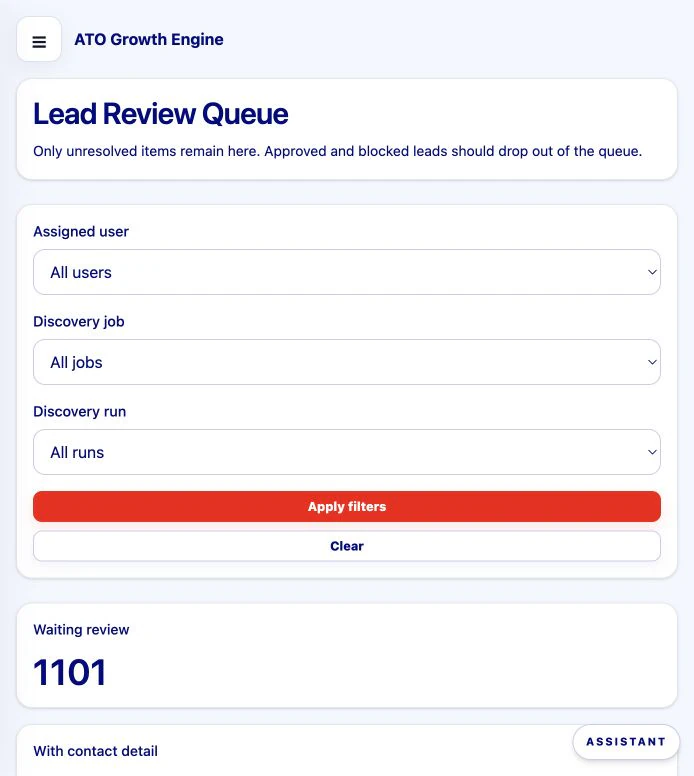
Approve, hold, block or reject.
AI can support discovery and analysis. It does not decide whether a lead is relevant or appropriate for contact. The unresolved queue exists to make that decision explicit before the workflow progresses.
- AI
- Researches and structures available evidence.
- Automation
- Creates records, routes them to review and updates state.
- Human
- Approves, holds, blocks or rejects the lead.
03 · Plan to delivery
AI-assisted planning remains subject to readiness and approval.
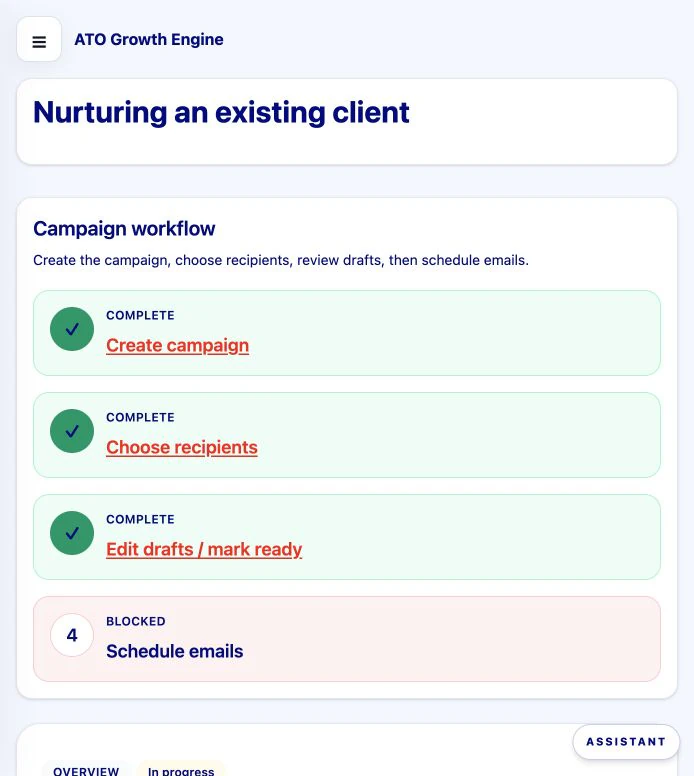
The campaign planner turns an outcome, audience and intended next step into a structured planning brief. The campaign workflow then makes completion and blockers visible before scheduling. No saved planning example was present in the available workspace, so this screenshot demonstrates the implemented planning interface rather than a completed live campaign.

04 · Conversation to business action
The workflow continues after a response.
A verified Call Agent handoff creates a Growth Engine conversation with captured lead context. From there, people can review the record and decide whether to open a lead, create an opportunity or take another follow-up action.


Responsibility
AI assists. Automation connects. People decide.
- AI
- Research · Analysis · Campaign planning · Drafting · Conversation support
- Automation
- Record creation · Routing · Status changes · Scheduling · Synchronisation
- Human control
- Lead relevance · Campaign approval · Content review · Sending · Follow-up decisions
My contribution
From operational problem to working product system.
I defined the product concept and workflow architecture, translated operational requirements into system behaviour, directed AI-assisted development, and tested and refined the journeys, approval states and edge cases.
Concept · Product design · Workflow architecture · Requirements · AI behaviour · AI-assisted development · Testing · Iteration
What I learned
A useful AI feature becomes more valuable when the surrounding workflow is designed too.
The work shifted the design question from “What can AI generate?” to “What information, decisions and controls are required for the whole process to work?”
That meant treating approval states, blockers, evidence, downstream records and follow-up as product features—not implementation detail.